
Canine Health
My Dog Ate Grass For Months Before The Lumps Came. I’m A Vet, And I Told Him To Stop.
Twenty-two years of telling owners “benign, nothing to worry about.” Then I lost my own dog at nine, pulled a decade of case files, and found the pattern I had been trained to ignore.


First they eat grass. Then they lick their paws. Then they slow down. Then the lumps appear. It’s not four separate problems—it’s one immune system screaming for help.
“By the time you notice the lump growing, the immune damage is already well underway. This is the most preventable problem I see in my practice every single week.”
– Dr. Sarah Martinez, DVMI’m about to share the research discovery that destroyed 22 years of veterinary confidence—and exposed why the “solution” I’d been recommending to clients was completely worthless.
But first, I need to tell you why your vet keeps saying “watch and wait.”
And it has nothing to do with laziness or ignorance.
For 22 years straight, I said the exact same thing.
Every single time I biopsied a soft lump and saw “benign lipoma” on the pathology report, I’d smile and tell the owner:
“Nothing to worry about. Just a harmless fatty tumor.”
I’d see the relief wash over their face.
Update the chart.
Move to the next appointment.
I felt like I was doing good medicine.
Until Max.

My own 6-year-old Border Collie mix.
Perfect genetics.
Flawless health records.
The dog I chose specifically because I knew how to keep him healthy.
When I felt that first lump on his shoulder, I did exactly what I’d done a thousand times before:
Fine needle aspirate.
Send it to the lab.
Wait for results.
“Benign lipoma.”
I actually felt relieved.
See? Even my own dog gets them.
Completely normal.
Then the second lump appeared.
Then the third.
By month six, Max had eight lumps.
All biopsied.
All “benign.”
I wasn’t worried.
This is what I see every day.
Happens to older dogs all the time.
Except Max wasn’t old.
He was seven.
By eighteen months, he had seventeen lumps.
He started moving differently.
Breathing harder.
The lumps weren’t just cosmetic anymore—they were crushing against his organs, restricting his movement.
At nine years old, I had to make the decision I’d helped hundreds of clients make.
Max should have lived to fourteen.
I gave him nine.
And that’s when I noticed the pattern.
I started to ask myself this one question:
How does a “healthy” dog with “benign” lumps die five years early?
So I pulled every case file from the past decade.
Every dog I’d diagnosed with lipomas.

I built a spreadsheet.
Age at first lump.
Number of lumps.
Lifespan.
But it wasn’t just shortened lifespans.
It was how they aged.
These dogs went from energetic to lethargic within months.
Owners would come back a year or two later—without their dog.
The lumps were a warning sign I’d been trained to ignore.

Owners would say:
“He just got old so fast.”
or
“It’s like she aged three years in one.”
7-year-old dogs acting like they were 13.
And there was something else.
Almost every single dog with multiple lumps had one behavior in common: obsessive grass eating.

“Is it normal that Bailey eats grass for 10 minutes every time we go outside?”
I’d always said yes.
“Dogs just do that. Probably settling their stomach.”
But what if it wasn’t settling their stomach?
What if they were craving something?
I started asking.
The lumpy dogs were desperately eating grass.
The healthy dogs weren’t.
So I searched:
“canine grass consumption immune function”
That’s when I found a Cornell study I’d never seen:
Dogs with immune dysfunction showed significant increases in grass consumption, seeking beta-glucans and polysaccharide compounds. This mirrors self-medication patterns in wild canids consuming medicinal fungi.
Medicinal fungi.

The study referenced wild wolves seeking out Turkey Tail mushrooms during illness.
The mushrooms were rich in polysaccharides that supported immune function.
Domestic dogs didn’t have access to Turkey Tail mushrooms.
So they were eating grass—desperately trying to get the compounds their immune systems were screaming for.
I kept clicking through studies.
Turkey Tail polysaccharides.
Immune restoration.
Gut barrier repair.
Then I found it:
Not because it attacked tumors.
But because it restored immune function.
Max had been eating grass for months before the lumps exploded.
I’d thought it was stress.
Or boredom.
He was trying to heal himself.
And I dismissed it.
His immune system was collapsing.
And his instincts were telling him to find Turkey Tail.
But Max didn’t have access to Turkey Tail.
He had access to my backyard grass.
And I told him to stop eating it.
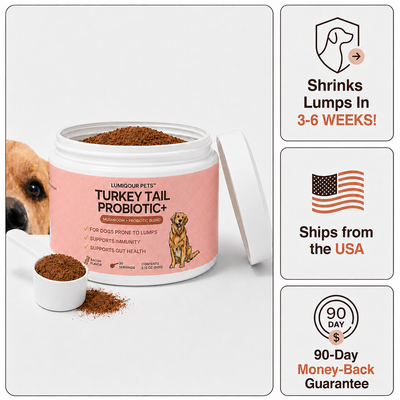
Turkey Tail+ from Lumiqor · 90-day money-back guarantee
The next morning, I called Dr. James Chen at UC Davis.
We’d done our residencies together.
“James, have you ever used Turkey Tail mushrooms in practice?”
Long pause.
“Sarah... how did you find out about that?”
“We’ve been using it in oncology for about eight years. Quietly. It’s not in standard protocols, so we only mention it to clients who ask about holistic options.”
“Why isn’t it standard?”
“Because no pharmaceutical company makes money off mushrooms. They can’t be patented. So they don’t get pushed through vet schools.”
This had existed the entire time Max was dying.
I ordered every Turkey Tail supplement I could find.
Started with my most desperate cases.
Dogs with 8, 10, 15 lumps.
Dogs aging too fast.
Dogs eating grass.

The first was Bailey, a 9-year-old Lab mix with twelve lumps.
Week two: Nothing.
Week four: Nothing.
Week eight: One lump maybe slightly smaller.
Bailey was still eating grass.
Still lethargic.
I tried a different brand.
Then another.
Then another.
Same story every time.
Minimal results.
Sometimes none at all.
I couldn’t understand it.
The University of Pennsylvania study showed dramatic immune restoration.
Dogs living months longer.
Tumors shrinking.
But the supplements weren’t working.
I spent three weeks buried in research papers.
That’s when I found a study from Japan that changed everything:
“Mushroom polysaccharides remain bound within chitin cell walls, rendering them largely indigestible to monogastric animals without sufficient chitinase enzyme activity.”
I had to read it three times.
Chitin is the hard cell wall that protects mushroom compounds.
Dogs don’t produce enough chitinase enzymes to break it down.
The Turkey Tail was passing straight through their digestive systems.
Undigested.
Unabsorbed.
Completely useless.
That’s why the supplements weren’t working.
The polysaccharides were locked inside cell walls the dogs couldn’t break open.
I called James back.
“The Turkey Tail you’re using in oncology—how are you getting it to actually absorb?”
“We compound it with specific probiotic strains. Lactobacillus acidophilus produces chitinase enzymes that break down the cell walls. Without it, you’re just creating expensive dog poop.”
“Why doesn’t anyone talk about this?”
“Because most supplement companies don’t know. Or don’t care. They slap ‘Turkey Tail’ on the label, charge $60 a bottle, and never ask if it’s actually being absorbed.”
I felt sick.
I’d been giving Bailey worthless supplements for two months while her immune system continued collapsing.
Just like Max.
James sent me the compounding protocol.


Turkey Tail extract.
Lactobacillus acidophilus.
Specific ratios to maximize chitinase production.
I started Bailey on it the next day.
Week one:
“Dr. Martinez, Bailey stopped eating grass. Completely. She used to graze for fifteen minutes every walk.”
Week three:
“She’s playing with toys again. I thought she was just old.”

Week seven:
Four lumps had vanished.
The remaining eight were noticeably smaller.
Her energy came back.
She started acting like a 5-year-old, not a 12-year-old.
Then the second dog responded.
Then the fifth.
Then the twentieth.
But here’s what haunted me:
I’d wasted two months giving Bailey regular Turkey Tail.
Two months watching her decline while I fed her a supplement that was literally passing through undigested.
How many clients had I sent home with Turkey Tail that didn’t work?
How many gave up after eight weeks, thinking “natural remedies don’t work for my dog”?
When the truth was: their dog never absorbed a single dose.
The supplement failed them.
Not the other way around.
Turkey Tail+ from Lumiqor · 1,000 mg Turkey Tail with 1 Billion CFU L. acidophilus
Last month, a client brought in Murphy, her 7-year-old Golden.
Covered in lumps.
Eating grass constantly.
I recognized the pattern immediately.
I explained the gut-immune connection.
The Turkey Tail research.
Why most Turkey Tail supplements are worthless.
The probiotic requirement for absorption.
She stared at me.
“Our last dog died at nine with lumps everywhere. The vet gave us Turkey Tail. We spent $300 over three months. Nothing happened. We thought we’d tried everything.”
She had tried everything.
She’d just been given a supplement that her dog couldn’t absorb.

Murphy’s on week six now with the probiotic-activated formula.
Five lumps have disappeared.
He stopped eating grass within ten days.
His owner sent me a video of him playing fetch—something he hadn’t done in over a year.
But here’s what keeps me up at night:
How many dogs are on Turkey Tail right now that isn’t being absorbed?
How many owners think they tried “the mushroom supplement” and it didn’t work—when they were actually just feeding unabsorbable powder to their dog?
How many vets recommend Turkey Tail without knowing about the chitin barrier?
Max was trying to save himself.
His instincts knew what his body needed.
I found Turkey Tail.
I gave it to him for his last four months.
And his body couldn’t absorb it.
I was so close.
I had the right answer.
But I was missing the one thing that made it actually work.
If I’d known about the probiotic requirement, Max would have been 12 years old right now.
Instead, I have eight years of guilt and a practice full of dogs I’m trying to save before it’s too late.
If your vet says “watch and wait”
- If your dog has lumps and your vet says “watch and wait,” ask them about gut-immune restoration.
- Ask them about Turkey Tail bioavailability.
- Ask them why your dog is eating grass when they never used to.
- Ask them if the Turkey Tail they’re recommending includes the probiotic strains required for absorption.
Because if it doesn’t, you’re wasting your money and your dog’s time.
The research exists.
The solution exists.
It just has to actually get absorbed.
After losing Max, I made it my mission to make sure other dogs didn’t die the same way.
I found a company called Lumiqor that formulates their Turkey Tail exactly the way the oncology research protocols specify—Turkey Tail extract combined with Lactobacillus acidophilus in the precise ratios required for chitin breakdown and maximum absorption.
No fillers.
No “kitchen sink” formulas with twelve different mushrooms.
Just the two ingredients that actually work together.
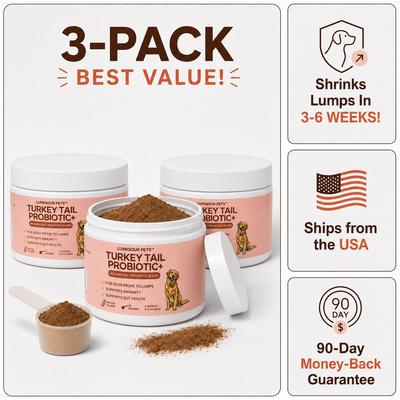
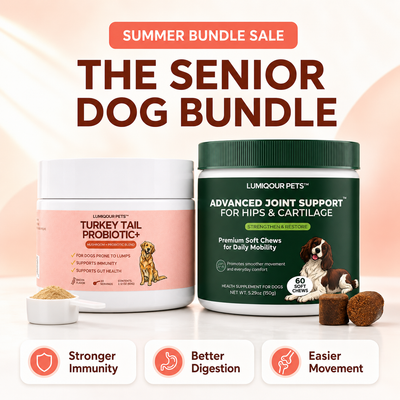
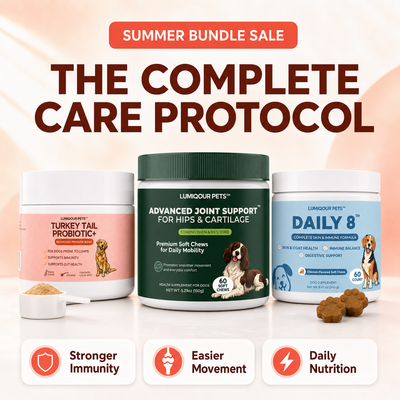
Turkey Tail+ by Lumiqor

- 1,000 mg organic Turkey Tail mushroom per scoop
- 1 Billion CFU Lactobacillus acidophilus, the strain that produces chitinase
- Two ingredients, no fillers or additives
- Bacon flavored powder, mixes into their normal food
- Vet formulated, third-party lab tested, made in the USA
- 90-day money-back guarantee
- Daily scoops by weight: 1 scoop up to 24 lbs, 2 scoops 25 to 50 lbs, 3 scoops 51 to 200+ lbs
Max never got this formula.
He never got the chance to heal the way his instincts were begging him to.
But your dog can.
And if your vet doesn’t know about the bioavailability issue—show them this letter.
Because every dog eating grass is trying to tell us something.
We just need to start listening.
And we need to give them something their bodies can actually use.
Click here for Turkey Tail+ from Lumiqor—the only formula I recommend.
The only formula I recommend · 90-day money-back guarantee · Ships from California
What other owners have written in
“My 12-year-old lab Charlie had a fatty lump on his ribcage that seemed to drain his energy. He’d lie on the floor for hours and had zero interest in going outside. After starting Turkey Tail+ the lump started feeling softer within a few weeks. By week 8 it had flattened noticeably and he actually wanted to go outside again, standing alert, tail up, like his old self.”
Jennifer K. Verified Buyer
“That hard lump on my 10-year-old Frenchie’s chest used to be the first thing my hand went to every time we cuddled. By week 3 on Turkey Tail+ it didn’t feel like a marble anymore, and by week 6 it was softer, flatter, and not the only thing I could see when he lay on his side. I still check it, but I don’t feel that same panic in my stomach anymore.”
Stacy M. Verified Buyer
“My 9-year-old Border Collie Luna had a fatty lump high up on her front leg near the shoulder. She’d pull away when we touched it. I didn’t think a supplement could do anything, but after two months on Turkey Tail+ the lump feels softer and doesn’t stick out as much. She lets us handle that leg again and jumps into the car on her own now.”
Kerry W. Verified Buyer

90-day money-back guarantee · Free shipping on orders over $60